Water is arguably the world's most important resource. Whether sourced from freshwater reserves like rivers or lakes, or reclaimed through desalination, it remains the primary engine of human activity and industry. Globally, we produce a staggering 350 trillion litres of treated water annually; however, one-third of that volume never reaches a consumer. Instead, it is lost due to invisible, underground leaks in our water piping networks. To put the scale of this waste into perspective: we lose 22 times more water daily through leakage than the global petroleum industry produces in oil. From a fiscal standpoint, this represents an estimated $260 million USD of water that is extracted, treated, piped, and ultimately lost very single day.
While water leaks may not carry the same immediate environmental stigma as oil spills, the impact can still be devastating. Beyond the staggering financial loss, these failures pose a direct threat to urban stability.
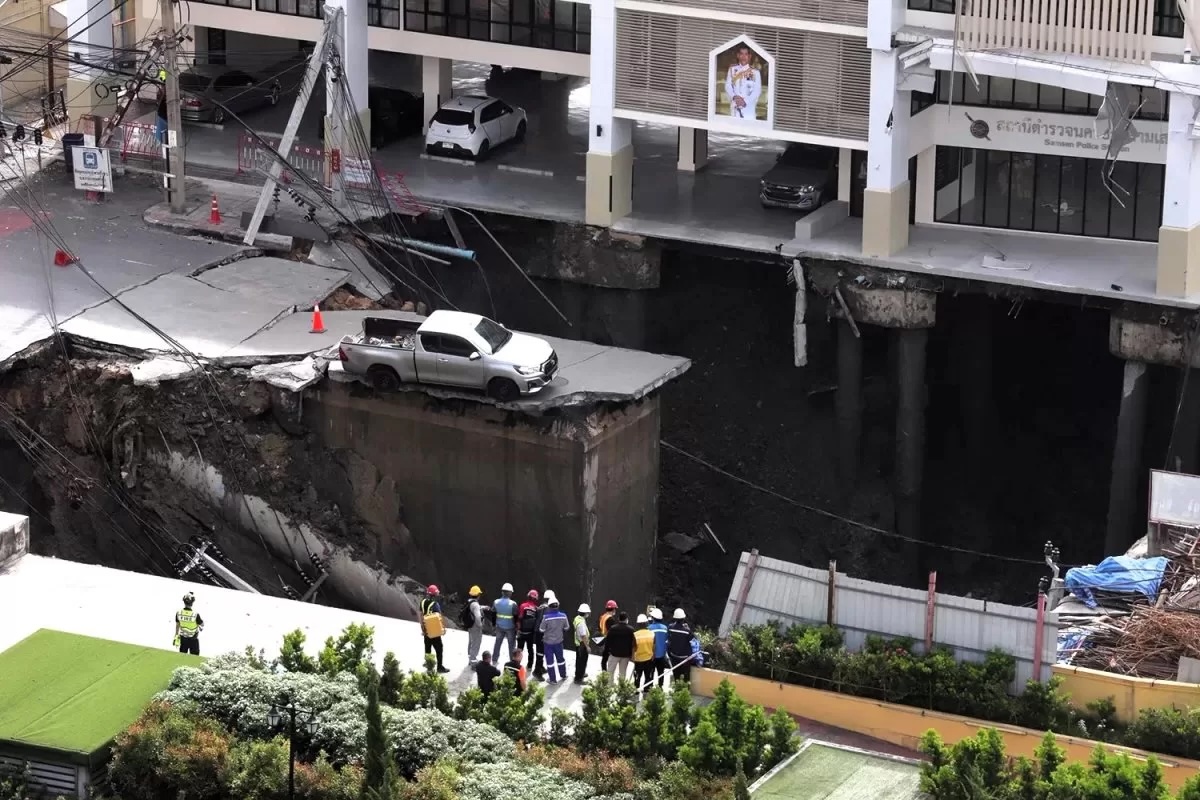
A recent high-profile example occurred in Bangkok, Thailand, where a massive intersection collapsed. The culprit? A persistent underground water leak. Water escaping from a fractured water pipe eroded the surrounding soil over time, eventually compromising the structural integrity of the ground above. The result was a catastrophic sinkhole that endangered commuters and paralyzed local infrastructure.
Unlike oil pipes, however, water pipes get very little attention. Oil is highly regulated and carries a higher price per barrel, its transport networks are outfitted with sophisticated leak detection. Water networks, conversely, often suffer from "silent" leaks that persist for months before being identified.
Traditionally, locating these leaks is a labor-intensified process. Teams of people have to be deployed with acoustic monitoring equipment to manually listen for the vibrations of escaping water. Just imagine walking around with a stethoscope, but instead of listening for somebody's heart beating in their chest, holding it to the ground and listening for the sound of leaking water in the middle of a dense metropolitan city like Bangkok. Any reduction in the search area doesn't just save time; it saves millions of gallons of treated water.
Sense Info Tech Co., Ltd., manages Bangkok's complex distribution network and faced a significant hurdle: data scarcity. They required a way to detect and localize leaks using only a single water flow rate sensor per District Metered Area (DMA).
Our goal was clear, utilize existing sensor data to identify and pin-point leaks faster than traditional manual sweeps.
To address the limitations of manual acoustic monitoring, we applied advanced deep learning to historical sensor data and managed to build both an AI-powered leak detection and localization mechanism. The leak detection system is trained to recognize the "fingerprint" of a water leak from flow rate (vs normal variation in flow rates) and the localization system helps assign leak probabilities across the DMA pipes network (the chance that it's here vs. anywhere else in the DMA).
Within a three month pilot, the models reduced the required search area by 33%, enabling faster intervention and significantly reducing non-revenue water loss.
Here is how we imagined and built this solution.
Traditional leak detection often rely on "static" risk factors—knowing that older pipes or specific materials (like galvanized iron) are more prone to breaking. While this helps identify vulnerable zones, it cannot tell engineers when a pipe broke.
To solve this, we needed to move from static analysis to dynamic detection. We hypothesized that a pipe burst creates a unique "transient signature"—a pressure wave that propagates through the water network. Our goal was to capture this invisible signal using the client's existing infrastructure: Remote Terminal Units (RTUs) measuring flow and pressure, and comparing them with historical maintenance logs.
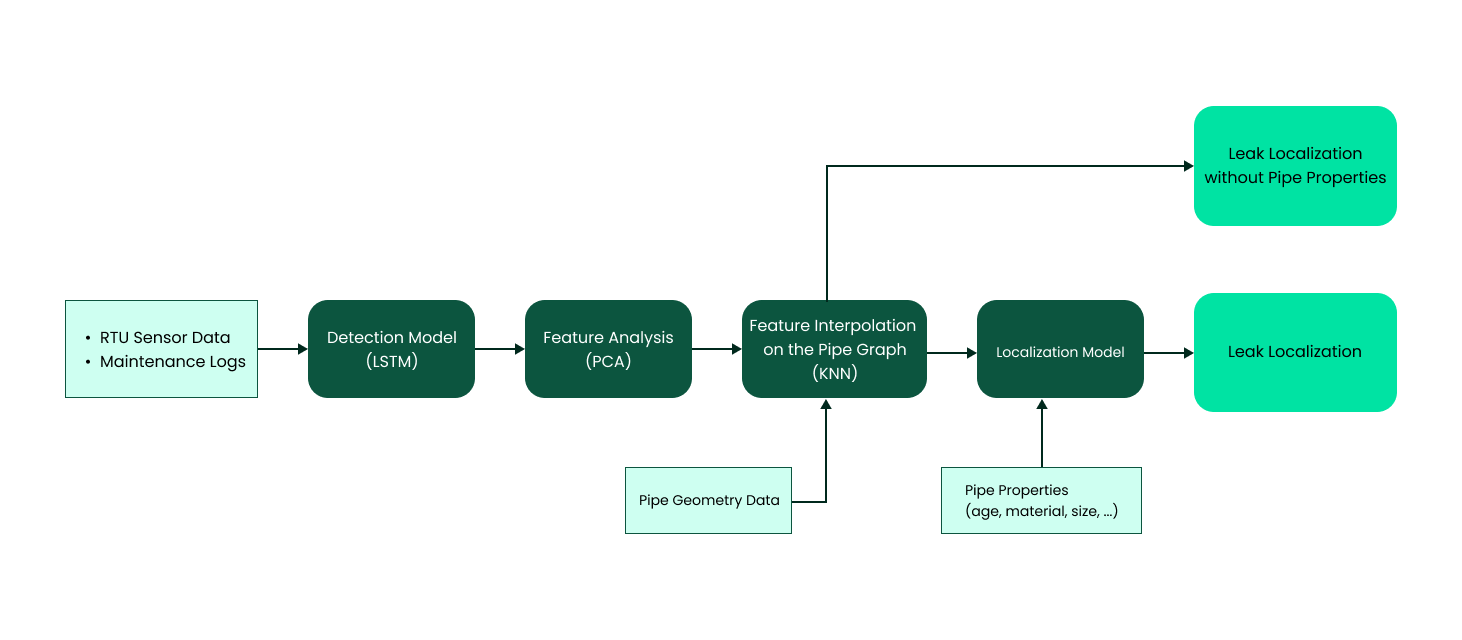
Because a leak involves both a time and a place, we separated the problem into two distinct stages: Detection and Localization.
1. Detection: Listening for the "Pulse" (Bi-LSTM)
First we needed to find the exact moment a leak occurred. We treated the water pressure and flow readings as a time-series sequence.
2. Localization: Mapping the Ripple (PCA + KNN)
Once the LSTM identified the leak's timestamp, we extracted the specific 100-minute pressure wave surrounding the event. To find the location, we analyzed the shape of the wave.
3. Validation: Benchmarking Against Ground Truth
A critical part of this project was proving that the model works when compared to real-world data. To do this, we utilized the client's maintenance logs, which contained the GIS coordinates of past repairs, and employed a Leave-One-Out (LOO) cross validation strategy.
Results:
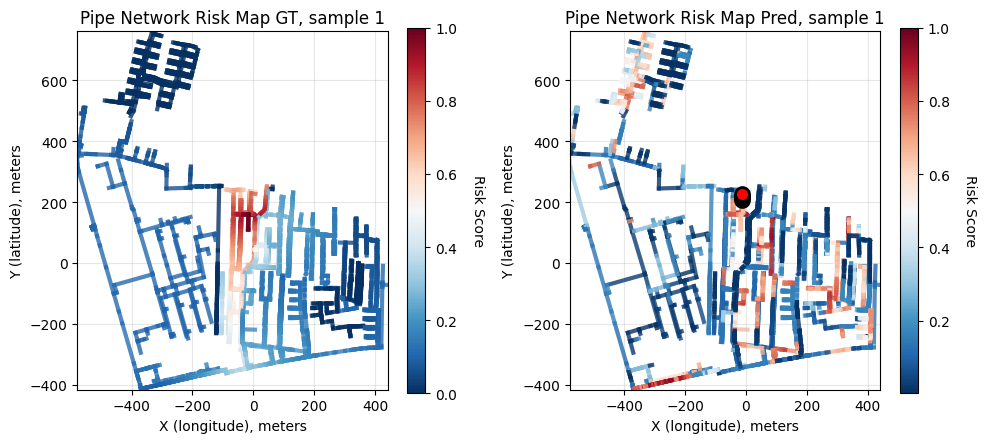
Achieving a 317-meter search radius is a significant step forward, but we aim to go further. Our findings suggest that purely data-driven models are limited by sensor density. The next frontier is Physics-Informed AI.
By integrating the laws of hydrodynamics directly into out neural networks, we can stimulate how pressure waves should travel through specific pipe topologies. This hybrid approach will allow us to predict leak locations with even greater precision, helping utilities save water, money, and time.
While this solution was pioneered for municipal water networks, its core logic is highly transferable. The same principles of dynamic pressure wave analysis can be applied to oil and gas pipelines, where even mirror leaks can lead to severe environmental and regulatory consequences.
Globally we are facing a crisis of aging infrastructure. As urban density increases, the margin for error shrinks; once a sinkhole appears, the damage is already done—both physically and economically. This AI framework offers a proactive, foundational technology to help utilities transition from reactive repairs to predictive maintenance. By preempting catastrophic failures, we aren't just saving resources, we are safeguarding urban stability.
Founded by a former senior research engineer at Google DeepMind, Recursive brings together world-class talent from across disciplines to engineer results where others can't.